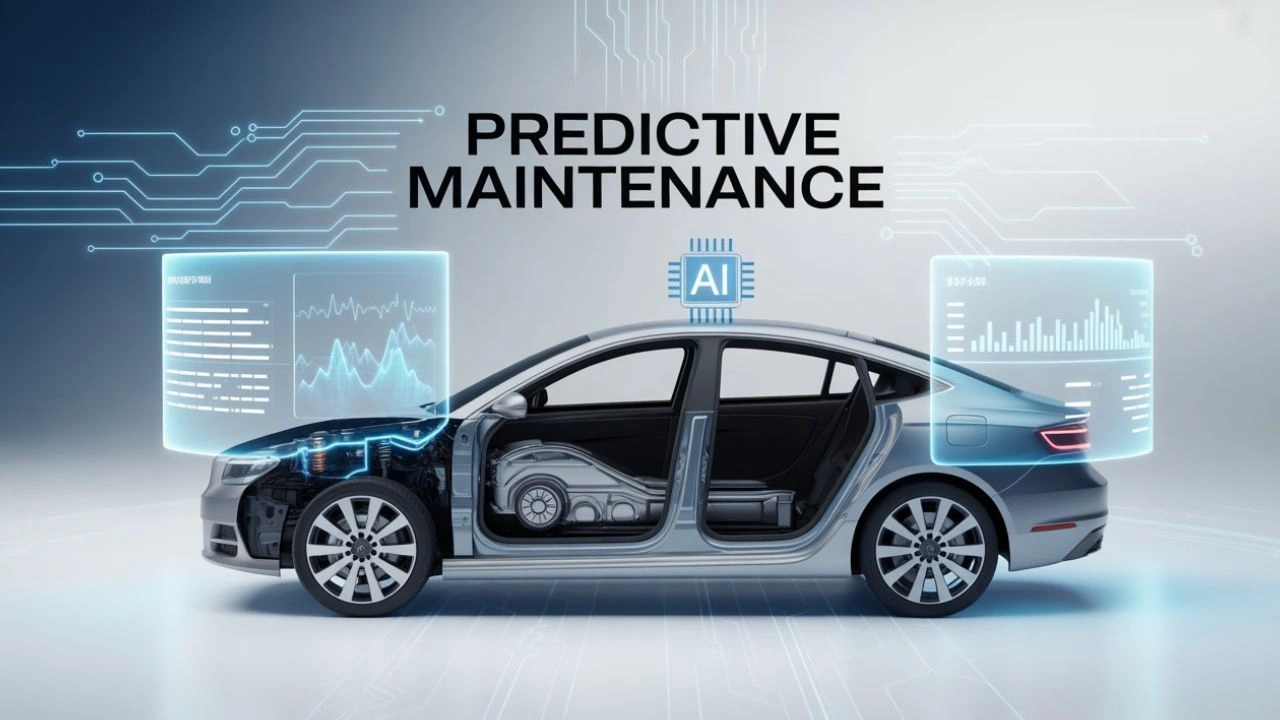
Predictive Car Maintenance Using AI: For decades, car maintenance followed a simple rule: fix it when it breaks, or service it on a fixed schedule. Oil every 10,000 km. Brakes when they squeal. Battery when the car won’t start. This reactive approach worked reasonably well in mechanical cars—but it also caused unexpected breakdowns, expensive repairs, and safety risks.
Today, that model is rapidly becoming obsolete.
Modern vehicles are equipped with dozens to hundreds of sensors, powerful onboard computers, and constant data processing. When combined with artificial intelligence (AI) and machine learning, these systems can now predict failures before they happen. This is known as predictive car maintenance, and it is quietly transforming how cars are serviced, how breakdowns are avoided, and how ownership costs are reduced.
This in-depth, Google Discover–optimised guide explains how predictive car maintenance using AI works, what on-board sensors monitor, which problems can now be detected early, and why this technology represents the biggest shift in vehicle reliability since fuel injection.
From Reactive to Predictive: A Major Shift in Car Maintenance
Traditional car maintenance falls into two categories:
1. Reactive Maintenance
- Repair after a breakdown
- Replace parts only when symptoms appear
- Often expensive and inconvenient
2. Preventive Maintenance
- Fixed service intervals
- Parts replaced based on mileage or time
- Safer than reactive, but still inefficient
Predictive maintenance is different.
Predictive Maintenance
- Uses real-time sensor data
- Detects abnormal patterns early
- Predicts component failure probability
- Recommends action before breakdown
Instead of asking “What mileage is my car at?”, AI asks
“How healthy is this specific component right now?”
Read Also: Nissan Tekton: A Bold New Compact SUV Aiming to Reinforce Nissan’s Presence in India
Why AI Is the Missing Piece in Car Maintenance
Cars have had sensors for years. What changed is intelligence.
The Problem with Raw Sensor Data
- Thousands of data points per second
- Human technicians can’t interpret all patterns
- Many failures develop subtly over time
What AI Does Better
- Learns normal vs abnormal behaviour
- Detects tiny deviations humans miss
- Connects patterns across systems
- Improves accuracy with more data
AI doesn’t just read data—it understands trends.
What On-Board Sensors Monitor in Modern Cars
Modern vehicles act like rolling diagnostic labs.
Key Sensor Categories
- Temperature sensors
- Pressure sensors
- Vibration sensors
- Electrical current sensors
- Flow sensors
- Position and speed sensors
Each sensor alone is useful. Together, they create a digital health profile of the vehicle.
Engine Health Monitoring Through AI
The engine is one of the biggest beneficiaries of predictive maintenance.
Sensors Involved
- Oil pressure and temperature
- Coolant temperature
- Knock sensors
- Air-fuel ratio sensors
- Crankshaft position sensors
What AI Can Predict
- Oil degradation before scheduled change
- Early bearing wear
- Cooling system inefficiencies
- Combustion irregularities
Instead of waiting for warning lights, AI can flag:
“Oil viscosity is degrading faster than normal due to heat stress.”
Transmission and Drivetrain: Predicting Expensive Failures Early
Transmission repairs are among the most expensive car repairs. AI changes that.
Monitored Parameters
- Transmission fluid temperature
- Shift timing
- Clutch engagement patterns
- Torque converter slip
Predictive Insights
- Fluid breakdown trends
- Early clutch wear
- Valve body issues
- Gear synchronization problems
AI can detect micro-delays in shifts long before drivers feel anything.
Brake Systems: From Wear Detection to Behavioural Analysis
Brakes no longer rely solely on mileage.
Sensors Used
- Brake pad wear sensors
- Wheel speed sensors
- ABS pressure sensors
- Temperature data
AI Capabilities
- Predict remaining pad life based on driving style
- Detect caliper drag early
- Identify uneven braking patterns
- Warn of brake fluid boiling risk
Instead of a generic “check brakes” alert, drivers receive specific, timely warnings.
Battery and Electrical System Intelligence
Modern cars suffer battery failures more often—not because batteries are worse, but because electronics demand more.
Battery Sensors Monitor
- Voltage stability
- Charge/discharge cycles
- Temperature
- Current draw patterns
What AI Predicts
- Battery end-of-life timeline
- Parasitic drain issues
- Charging system inefficiencies
This allows warnings like:
“Battery health declining faster than expected—replacement recommended within 2 months.”
Cooling System Failure Prevention
Overheating causes catastrophic damage. Predictive AI helps stop it early.
Monitored Data
- Coolant flow
- Temperature gradients
- Fan activation patterns
AI Detection
- Partial radiator blockage
- Failing water pump
- Thermostat sticking intermittently
These issues often go unnoticed until overheating occurs—AI catches them early.
Suspension, Steering, and Ride Quality Monitoring
Predictive maintenance isn’t limited to powertrain systems.
Sensors Used
- Accelerometers
- Wheel speed sensors
- Steering angle sensors
What AI Detects
- Shock absorber degradation
- Bushing wear
- Wheel alignment drift
- Bearing wear
The system notices subtle changes in ride behaviour before noise or vibration appears.
Tire Health and Predictive Wear Analysis
Tires are becoming intelligent components.
Data Sources
- Tire pressure monitoring systems (TPMS)
- Wheel speed data
- Temperature sensors
AI Insights
- Predict uneven wear
- Detect alignment issues early
- Estimate remaining tread life
- Warn of overheating risks
This prevents blowouts and improves fuel efficiency.
How AI Learns: Individual Car vs Fleet Intelligence
AI uses two learning layers.
1. Vehicle-Specific Learning
- Learns your driving style
- Understands your environment
- Adapts predictions accordingly
2. Fleet-Wide Learning
- Aggregates data from thousands of vehicles
- Identifies failure patterns
- Improves prediction accuracy continuously
Your car benefits from collective experience without sharing personal driving details.
Predictive Maintenance vs Warning Lights
Traditional warning lights are reactive.
| Warning Lights | Predictive AI |
| Triggered after threshold breach | Triggered before failure |
| Binary (on/off) | Gradual risk assessment |
| Generic | Personalized |
| Often too late | Early and actionable |
AI replaces panic lights with smart guidance.
How Predictive Maintenance Reaches the Driver
AI insights are delivered through:
- Dashboard messages
- Infotainment notifications
- Smartphone apps
- Dealer service alerts
Instead of vague alerts, drivers get clear recommendations.
Benefits for Drivers: Why This Matters
1. Fewer Breakdowns
Problems are fixed early, not roadside.
2. Lower Repair Costs
Early repairs are cheaper than failures.
3. Improved Safety
Critical systems are monitored continuously.
4. Better Ownership Planning
Predictive timelines help budget repairs.
5. Longer Vehicle Life
Components are protected from catastrophic damage.
Benefits for Service Centers and Manufacturers
Predictive maintenance also improves service quality.
- Accurate diagnosis
- Reduced unnecessary part replacement
- Faster repair times
- Better customer trust
Workshops move from guesswork to data-driven service.
Common Myths About AI-Based Car Maintenance
Myth 1: It’s Only for Luxury Cars
Reality: Many mid-range cars already use basic predictive systems.
Myth 2: It Replaces Mechanics
Reality: It empowers mechanics with better information.
Myth 3: It’s Invasive
Reality: Data is anonymized and vehicle-focused, not personal.
Myth 4: It’s Always Accurate
Reality: AI improves over time but still requires human judgment.
Limitations of Predictive Maintenance Today
While powerful, AI isn’t magic.
Current Challenges
- Sensor failures still occur
- Software bugs can affect alerts
- Not all mechanical issues are predictable
- Driver behavior still matters
Predictive maintenance reduces risk—it doesn’t eliminate it.
Electric Vehicles and AI Predictive Maintenance
EVs are especially suited to AI monitoring.
Why EVs Benefit More
- Fewer mechanical parts
- Heavy reliance on electronics
- Battery health critical to usability
Predictive systems track:
- Battery degradation
- Motor efficiency
- Thermal management
EV ownership without predictive maintenance would be risky.
The Future: Fully Autonomous Maintenance Planning
Where is this heading?
Coming Innovations
- Automatic service scheduling
- Parts pre-ordering before failure
- Remote diagnostics and software fixes
- Predictive recalls before issues spread
Cars will soon book their own service appointments.
What Drivers Can Do Today to Benefit More
Even with AI, owner habits matter.
Smart Owner Practices
- Don’t ignore early warnings
- Keep software updated
- Drive long enough to collect accurate data
- Use manufacturer-recommended parts
AI works best when humans cooperate.
Read Also: Mahindra XEV 9e: Redefining the Electric SUV Experience in India
Buying a Car? Predictive Maintenance Should Matter
When choosing a new or used car, consider:
- Sensor coverage
- Connected services
- Software update support
- Diagnostic transparency
Predictive capability is becoming as important as engine power.
Conclusion: Predictive Maintenance Is the End of Surprise Breakdowns
Predictive car maintenance using AI represents a fundamental shift in how vehicles are cared for. Instead of reacting to failures or relying on crude mileage schedules, cars now monitor themselves, learn from data, and warn drivers intelligently.
This technology:
- Saves money
- Improves safety
- Extends vehicle life
- Reduces stress
The biggest change isn’t technical—it’s psychological. Drivers no longer have to wonder “What might fail next?”.
With AI and on-board sensors, cars are finally learning to speak up before they break down.